
Onslow City Directory Collections
Historical city directories for Onslow are concentrated in local-history collections rather than in one countywide database. The strongest starting point is the Tucker Littleton Room at Jacksonville Main Library. Its holdings combine city directories, telephone books, census tools, microfilm, family files, and newspapers. The online counterpart is a 1948 Jacksonville volume cataloged by DigitalNC. Together, those sources make it possible to bridge an early listing, later printed years, and a modern parcel record without treating them as one continuous record.
| Collection | Years | Where Held | Access |
|---|---|---|---|
| Jacksonville city directory, Carolina Publishing Co. | 1948 | DigitalNC catalog, UNC Wilson Special Collections Library | Free catalog and scanned volume online |
| Jacksonville city directories | 1960-2019 | Tucker Littleton Room, Jacksonville Main Library | Consult the local-history collection |
| Jacksonville telephone books | 1957-present | Tucker Littleton Room | In-person research collection |
| Federal census for Onslow County | 1790-1950 | Tucker Littleton Room workstation | Ancestry Library Edition at the library |
| Onslow miscellaneous records | 1732-1950 | North Carolina State Archives | Finding aid, then repository request |
The documented shelf has gaps. The library reports directory years from 1960 through 2019, while the digitized Jacksonville item is from 1948. No separate reverse or criss-cross title was identified in the reviewed library material. Ask staff for a reverse city directory, cross-reference volume, or street section by those names, and note the volume's year and geographic reach before relying on it. A missing volume is a gap in the trail, not proof that a household was absent.
Note: Record the publication year before comparing any directory address with a current map or deed.
Onslow City Directory Research Shelf
The Tucker Littleton Room is built for the kind of work a city directory starts. Its Onslow microfilm includes land entries, deeds, tax lists, court minutes, marriage bonds and licenses, wills, birth and death material, and military-discharge indexes. It also keeps family-name vertical files, although those donated files vary in depth and should be cited as repository leads rather than treated as official proof. The room has a genealogy workstation, internet access, and a microfilm or microfiche reader. The county lists prints and copies at $0.20 per page and asks visitors to confirm hours before a trip.
The Onslow genealogy and local-history page identifies the library research room and its local databases.
The library setting matters because the printed city directory, census access, and microfilm can be checked in the same research visit.
The county's Tucker Littleton resources listing describes the local collection categories.
A telephone-book year or newspaper clipping can help test whether a city directory entry belongs to the same person, address, and period.
Onslow's 1948 Jacksonville Directory
The cataloged 1948 Jacksonville city directory is an unusually direct snapshot of an early postwar town. DigitalNC identifies the creator as Carolina Publishing Co. and the repository as UNC Wilson Special Collections Library. Its statistical review uses a 1945 interim-census figure of 3,000 and notes one hospital, one bank, six churches, a semiweekly newspaper, and about 1,000 telephones. Those figures describe the directory's period. They do not describe present-day Jacksonville or a current household.
The DigitalNC Jacksonville directory catalog record links the historical item to its repository description.
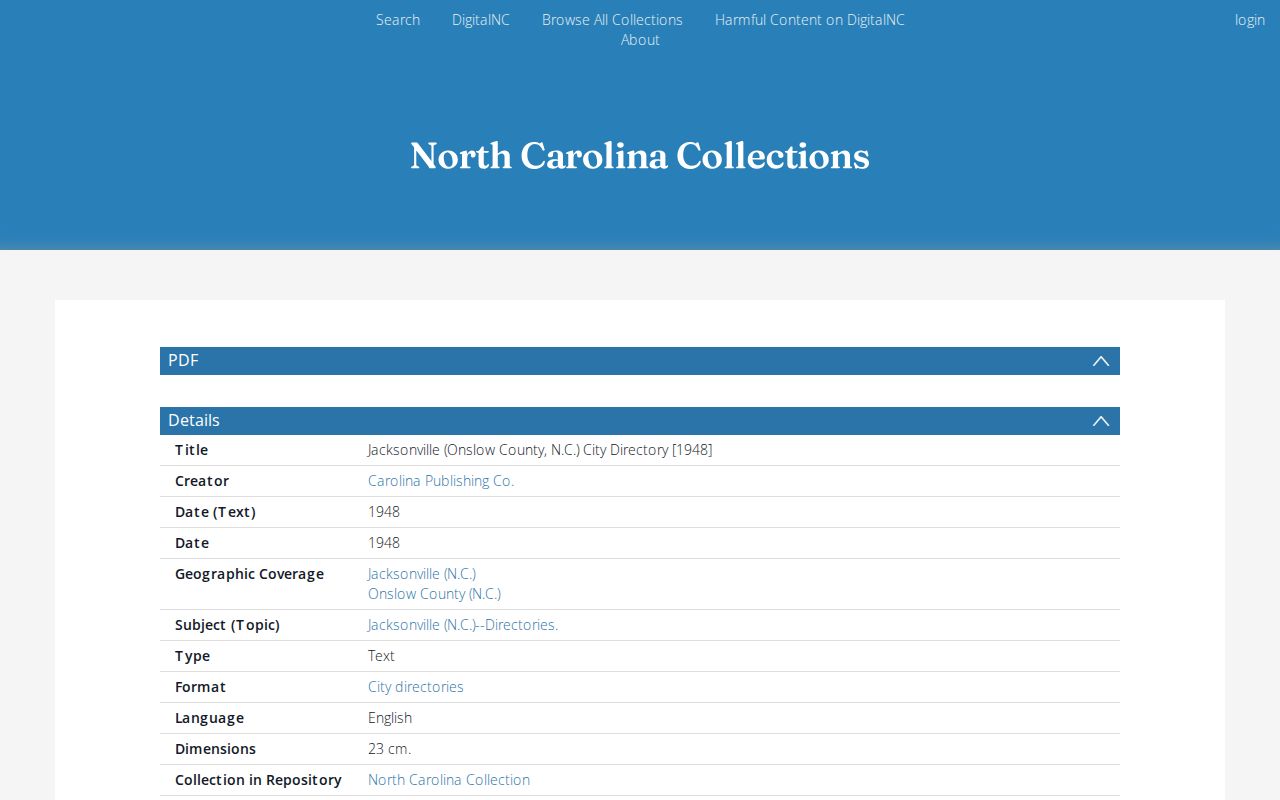
Use the catalog title, year, repository, and image or page number in notes so another researcher can return to the same entry.
The 1948 volume is useful for a surname or street in Jacksonville. It is not a substitute for the later city directory shelf, for a deed, or for a census schedule. For coastal and rural places elsewhere in Onslow, begin with the repository that fits the community rather than assuming Jacksonville coverage reaches every address.
Reading an Onslow City Directory
A city directory entry should be read as a compact historical note. In the inspected 1948 Jacksonville volume, the surname comes first, a spouse often appears in parentheses, an abbreviated occupation or role may follow, and some addresses carry an (O) mark. The sample supports using the mark as the volume's own ownership notation, but it does not establish title by itself. Read the front matter or abbreviation key before expanding a short form into a claim.
| Name | Surname followed by a given name or initials. Try spelling and initial variants. |
|---|---|
| Household clue | A spouse may appear in parentheses. It is a period clue, not current relationship proof. |
| Occupation or role | An abbreviated historical description that supplies context for that publication year. |
| Street address | The listed Jacksonville number and street. Compare it with dated maps and the deed trail. |
| Ownership mark | (O) appears beside some addresses in the inspected directory. Confirm the volume legend first. |
| Telephone reference | A historical contact or business clue. Old exchanges and numbers are not current contact data. |
- Criss-cross directory
- An address-first directory arrangement, if a repository holds one. It can lead from a street number to a listing for a specific publication year.
- Householder index
- A name-led listing of heads of household or listed persons. It may leave out other people in the home.
- Abbreviation key
- The legend that tells a reader how the publisher used marks, initials, and short forms. Photograph or transcribe it with the entry.
Onslow Directory Geography
Onslow County is not one city records system. Jacksonville is the county seat, but the county history also identifies Holly Ridge, Richlands, Swansboro, North Topsail Beach, part of Surf City, and unincorporated Sneads Ferry. A city name, mailing place, ZIP code, and legal jurisdiction can point in different directions. Before matching a directory address to a current parcel, check the city-limit or ETJ layer in county GIS and account for annexation, subdivision, or changed street numbering.
The Jacksonville history gives the local account of Wantland's Ferry, the 1842 naming, the 1849 town layout, and the growth that followed the 1940 Camp Lejeune decision.
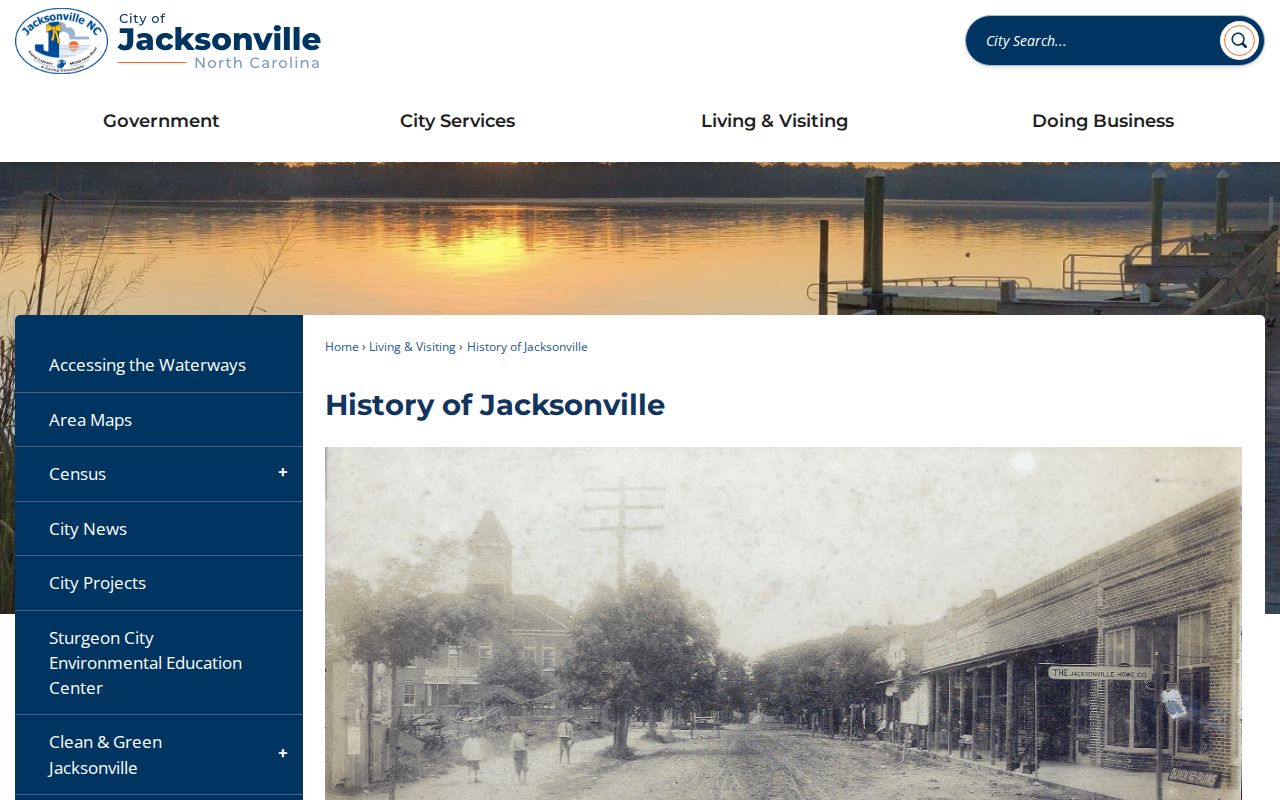
That history helps explain why an old Jacksonville city directory address may need a map and deed check before it is matched to a present parcel.
The New River's headwaters and mouth are both in Onslow County, according to the county history. River, coast, installation, and rural geography are practical research facts: an address near a boundary can be served by a different municipality or delivery area than its place name suggests.
Onslow Directory Research Rooms
Jacksonville is not the only place to pursue a local history question. The Onslow County Museum Research Room in Richlands is appointment-based and holds local-history and genealogy volumes, architectural-history files, family files, documents, photographs, and artifact information. It is a good fit for a Richlands-area house or family question after a directory has supplied a name or approximate era. Its materials are reference leads, not a promised name index.
The Onslow County Museum Research Room publishes the appointment-based research option.
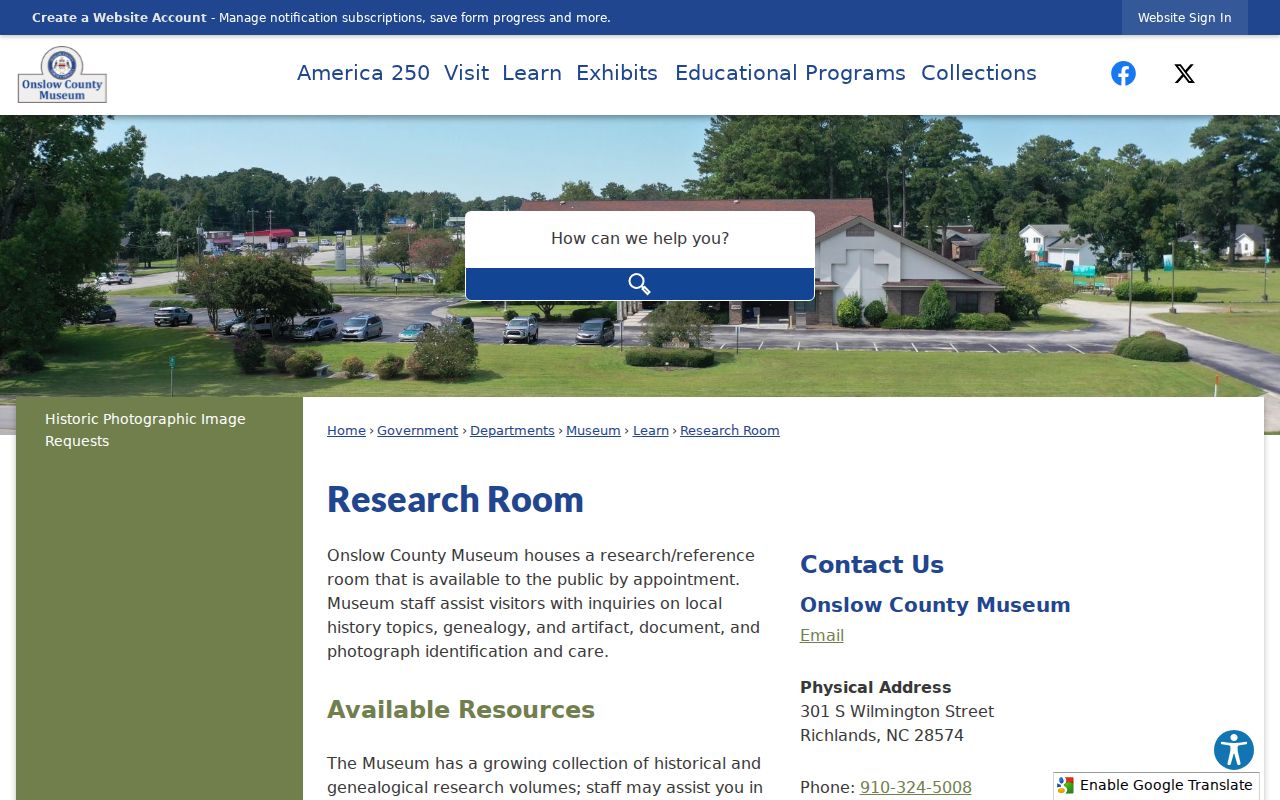
Richlands research can add architectural or family context that a city directory line cannot carry.
For Swansboro history, the Swansboro Heritage Center lists a public research room open Saturday and Sunday from 1 to 4, with appointments encouraged. Its published contact information makes it the more sensible first call for a Swansboro property, family, or maritime question.
Contacting the repository first can confirm access, copying options, and whether the collection actually covers the neighborhood and year in question.
Tracing an Onslow City Directory
Follow a household through the directory years one publication at a time. Start with the earliest confirmed listing, copy the spelling exactly, and carry forward only facts that repeat in a dated source. The Tucker Littleton Room gives researchers a way to pair the 1960-2019 directory run with telephone books, the federal census collection, newspapers, and microfilm. The historical volumes are the evidence. A later parcel card cannot retroactively tell who was listed in an earlier city directory.
- Locate the earliest name or address entry and note the publication year, page, spelling, and every printed mark.
- Check the next available city directory year for the same name, a spouse reference, a revised address, or a disappearance.
- Pair the period with the matching federal census schedule, available for Onslow through 1950 at the library workstation, while allowing for publication and enumeration dates to differ.
- Use telephone books and Jacksonville newspapers, held from 1957 and 1938 respectively, to test a move or address change between directory years.
- For a parcel question, compare the dated address with a deed, plat, and GIS record. The backward address workflow belongs on the Onslow previous residents search.
A name leaving a directory can mean a move, death, a changed listing style, or a missed issue. An obituary or newspaper notice is a lead, not a certificate. The State Archives finding aid can identify Onslow court, church, election, citizenship, marriage, jury, military, and name-related series from 1732 through 1950 when the library shelf ends.
Onslow City Directory Dates
Directory research works best when every date has a source type attached to it. Publication dates tell when a listing was compiled. Census dates describe enumeration. A deed's execution and recording dates can differ. Map layers and parcel cards have their own update cycle. Keeping those labels apart prevents a clean-looking but false household timeline.
- 1734: Onslow County formed, according to the county history.
- 1842 and 1849: Jacksonville was named and then laid out, according to the Jacksonville history.
- 1948: Carolina Publishing Co. issued the scanned Jacksonville city directory.
- 1957: The Tucker Littleton Room's Jacksonville telephone-book run begins.
- 1960-2019: The library reports its Jacksonville city directory holdings for these years.
For early land work, the Onslow Register of Deeds says deed books reach from 1734 to the present, while its modern certified-date utility separates later index paths. Use the older books, library microfilm, and archives when a city directory does not reach far enough back. That layered approach is more reliable than forcing one publication type to answer every historical question.