
Onslow Previous Residents by Era
The trail behind an Onslow address changes with the era. Current GIS and tax data give a parcel identifier and a present assessment label. Recorded deeds supply transfer instruments and legal descriptions. Historical directories, telephone books, newspapers, and census schedules can add the household layer that a deed cannot show. The Tucker Littleton Room and the State Archives provide the documented in-person and repository paths when a name or address does not appear in a current portal.
| Source | Years It Covers | Where Held | What It Shows |
|---|---|---|---|
| Onslow deed books | 1734-present | Register of Deeds eSearch and deed books | Recorded transfers, parties, legal descriptions, and book or page references |
| Pre-95 real-estate index | 1977-1994 | ROD Certified Dates and eSearch | Separate historical index route for real-estate research |
| Consolidated real-property index | 1995-current | ROD Certified Dates and eSearch | Later indexed real-property records |
| Jacksonville directory and later shelves | 1948; 1960-2019 | DigitalNC and Tucker Littleton Room | Published name, address, and period household clues |
| Federal census and local microfilm | 1790-1950 | Tucker Littleton Room | Household context, land, tax, court, and family-history leads |
| Onslow miscellaneous records | 1732-1950 | North Carolina State Archives | Court, church, election, military, marriage, and name-related series |
Start with the source closest to the period. A recent transfer is best followed through the deed index. A mid-century address may be better served by the library's city directories and telephone books. An early address can require a deed book, land entry, tax list, court minute, or archive series instead of a modern search form.
Onslow Previous Residents in Directories
For past residents in Jacksonville, use the historical directory shelf before trying to infer occupancy from a modern property card. The documented local pattern is a scanned 1948 Jacksonville directory, then library-held city directories from 1960 through 2019. The same library reports Jacksonville newspapers from 1938 forward and telephone books from 1957 forward. Those overlapping series can narrow a move to a span between publication years, but none proves that a person stayed at the address all year.
The DigitalNC catalog record for the 1948 Jacksonville directory identifies Carolina Publishing Co., the repository, and the scanned item. In the inspected volume, spouses often appear in parentheses and some addresses use an (O) marker. Treat those marks as directory conventions and read the volume's abbreviation key. A listed owner mark is not a substitute for a deed image, and a historical telephone reference is not a current contact detail.
The complete historical shelf and entry-reading method are collected in the Onslow city directory collections. For a backward address trail, copy the page, publication year, name spelling, address, and any mark exactly. Then compare the next available directory year rather than filling a gap with an assumption.
Note: A directory listing dates the publication, not a person's arrival or departure from an address.
Onslow Previous Residents Record Dates
The Register of Deeds makes a useful division between surviving books and later index paths. The county says deed books from 1734 to the present can be viewed online. Its Certified Dates utility separately lists pre-95 real estate from January 1, 1977 through December 31, 1994 and consolidated real property from January 1, 1995 through the displayed current endpoint. The public eSearch system also lists Indexed Records, Quick Name, Advanced Name, Property, Book/Page Number, File Number, Date Range, Pre-1976 Dates, and Certified Dates modes.
Use the Onslow Register of Deeds eSearch for guest access and the Certified Dates utility to see the separate coverage paths. The eSearch migration notice means a result can move between interfaces, so preserve the source URL and the date checked. When an earlier name or address is hard to locate, the pre-1976 or pre-1977 historical route and deed book images can be more useful than a modern name search.
The Onslow genealogy websites page points researchers to historical newspapers, DigitalNC, Sanborn resources, the museum, cemeteries, and other local repositories.
Those links form a fallback chain when an index miss reflects a changed street name, a gap in digitization, or a record held outside the modern portal.
Onslow Previous Resident Deed Chain
A deed chain follows the parcel, not just the street number. Begin with the Onslow GIS viewer or Tax Office search to identify the parcel, PIN, tax account, situs address, and any available deed book or page reference. The assessment record is a starting point. The recorded instrument is the source for the transfer itself. A mailing address can differ from the situs address, and a deeded owner is not automatically the person who occupied the property.
- Find the present parcel in the Onslow GIS viewer and write down the parcel or PIN, legal description, and deed book or page reference shown.
- Check the tax account for the property address and account identifiers, then keep the tax label separate from the recorded ownership trail.
- Open the current purchase deed in ROD eSearch by book and page, file number, property lead, or party name. Read the image rather than relying only on an index label.
- Take the seller from that deed and search the seller as a prior grantee to locate the instrument by which that person acquired the parcel.
- Repeat the process backward, recording both execution and recording dates, legal descriptions, plats, and any parcel changes. Move to deed books, microfilm, or archive sources for earlier material.
- Grantor
- The party conveying an interest in a recorded deed. A grantor is not necessarily an occupant of the address.
- Grantee
- The party receiving an interest in the deed. Searching a prior owner as grantee can locate that owner's purchase instrument.
- Chain of title
- The sequence of recorded transfers and related instruments for the parcel. It needs document-by-document review.
- Legal description
- The deed's parcel description, such as lot, map, metes and bounds, or other recorded reference. It survives street-number changes better than a civic address.
The eSearch index can lead to an instrument, but it does not make a title opinion. Compare later deeds, plats, deeds of trust, satisfactions, cancellations, liens, judgments, foreclosures, or estate records when those records are present and relevant to the parcel history.
Onslow Previous Residents and Old Streets
Old street names and new parcel geometry are common reasons an address trail breaks. Onslow GIS maintains E911 streets, property addresses, tax parcels, city-limit and ZIP layers, but the county warns that recording-to-map updates can lag. An older deed may use a route, landmark, former road name, map reference, or legal description that does not look like the present civic address. Parcel splits can also turn one older tract into several current records.
Jacksonville's history adds another local caution. The city grew around Wantland's Ferry, was named in 1842, laid out in 1849, and changed sharply after the 1940 Camp Lejeune decision. The Jacksonville history also notes later annexation near Camp Lejeune. For a street near the old courthouse or ferry geography, compare the directory year with a plat, deed description, and current GIS layer before declaring it the same location.
County history identifies Onslow's communities as including Holly Ridge, Richlands, Swansboro, North Topsail Beach, part of Surf City, and unincorporated Sneads Ferry. An address's city name or ZIP does not settle jurisdiction. That distinction matters when looking for an older permit, municipal file, or rural parcel record.
Onslow Previous Residents in Archives
Newspapers and archives add context after the address, deed, and directory years are in hand. Tucker Littleton holds Jacksonville newspapers from 1938 forward and can pair them with telephone books, land records, tax lists, court minutes, and family-name files. An obituary, wedding notice, or civic item may connect a name with a place and date. It remains a secondary source. Confirm a transfer with the deed image and a vital event with the appropriate certificate or official record.
The North Carolina State Archives finding aid covers Onslow material from 1732 through 1950, including court, election, church, citizenship, military, marriage, jury, and name-related records. Identify the series, date span, and repository before requesting a box or copy. This avoids treating a broad catalog result as if it were an indexed household record.
The Onslow marriage-license requirements page describes the local vital-records channel.
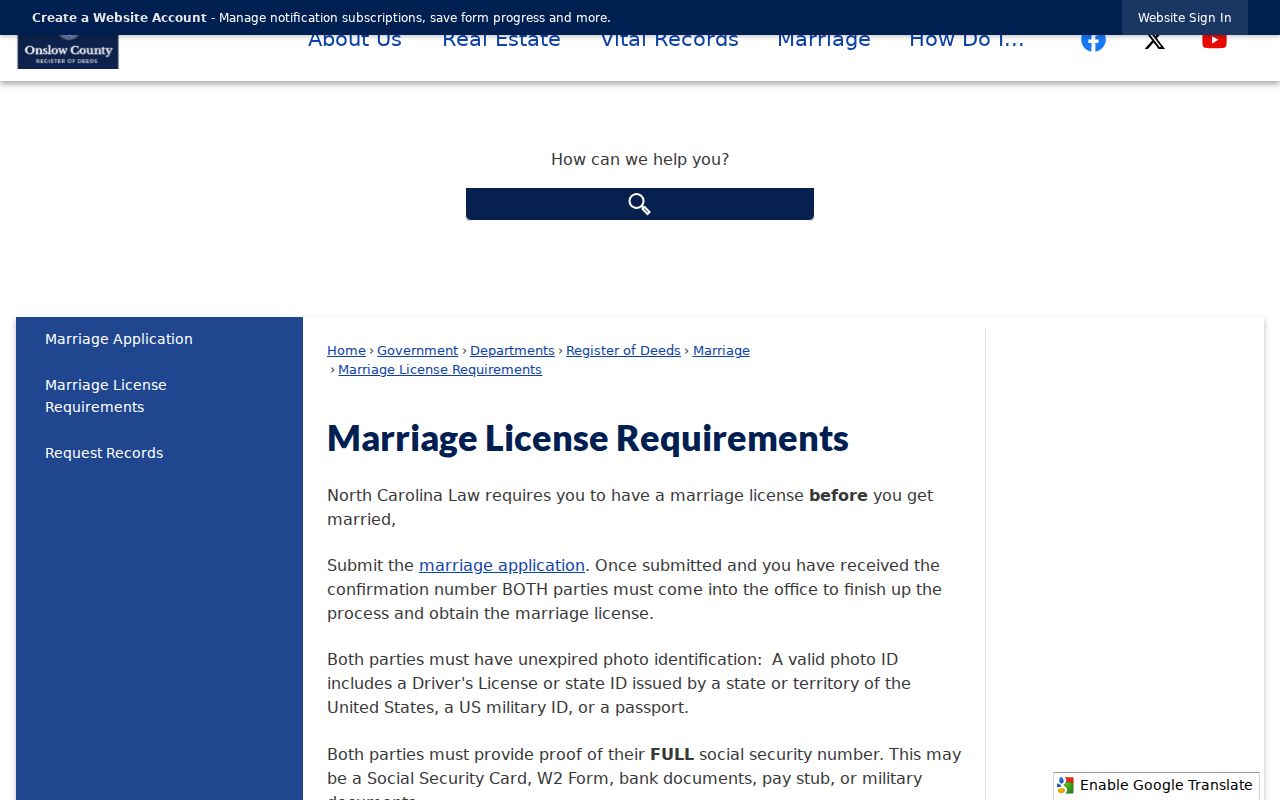
A marriage document can establish a dated event only through the official access process. It should not be turned into an unsupported claim about where either person lived.
Onslow Previous Residents Household Trail
Past residents are often found by crossing the address trail with household sources. A deed can identify a party to a transfer, but it may not name every person who lived at the property. A city directory can list a household head or a person at an address for its publication year. A federal census can show a household at enumeration, and a newspaper can bridge years between the available directories. Keep each source in its lane and retain the date type: published, enumerated, executed, recorded, or mapped.
- Choose one dated directory or telephone-book entry for the address and record its page, spelling, street form, and any ownership notation.
- Find the nearest available federal census year in the Tucker Littleton Room's 1790-1950 collection. Compare household details without assuming the directory and census were compiled on the same day.
- Check Jacksonville newspaper years from 1938 forward for an address, move, obituary, or community notice that fits the same period.
- Return to the deed chain to see whether the parcel changed hands, was subdivided, or acquired a new legal description between those dates.
- Write the result as a sourced timeline, not as a continuous list of occupants. Mark any unresolved gap plainly.
Citing Onslow Previous Residents
A strong historical-address note identifies the source before it identifies a person. For a directory, keep the title, publication year, publisher, repository, page or image, and date accessed. For a deed, keep the grantor, grantee, execution date, recording date, book and page, instrument reference, legal description, and image source. For a newspaper or archive item, retain the title, issue or series date, repository, page or box reference, and a stable link when available.
That detail lets another researcher distinguish a 1948 city directory listing from a later tax label or a current GIS map. It also makes an uncertainty visible. If a street name, parcel, or surname does not line up, record the mismatch and return to the relevant custodian or research room rather than smoothing it over.
Note: A useful address timeline labels each date as publication, enumeration, filing, recording, mapping, or delivery data.